Anatomy of a Tuning Fork: Parts, Weights and Frequencies Explained
If you're shopping for your first tuning fork, the product names can read like a foreign language.
Weighted or unweighted?
C128 or 136.10 Hz?
Mid Ohm, Otto or Solfeggio?
The good news is that the parts of a tuning fork are simple, and most product names are built from them. Below, we walk through each part using a labelled diagram. Once you know them, you'll be able to read any fork's name and know exactly what you're getting.
The Five Parts of a Tuning Fork
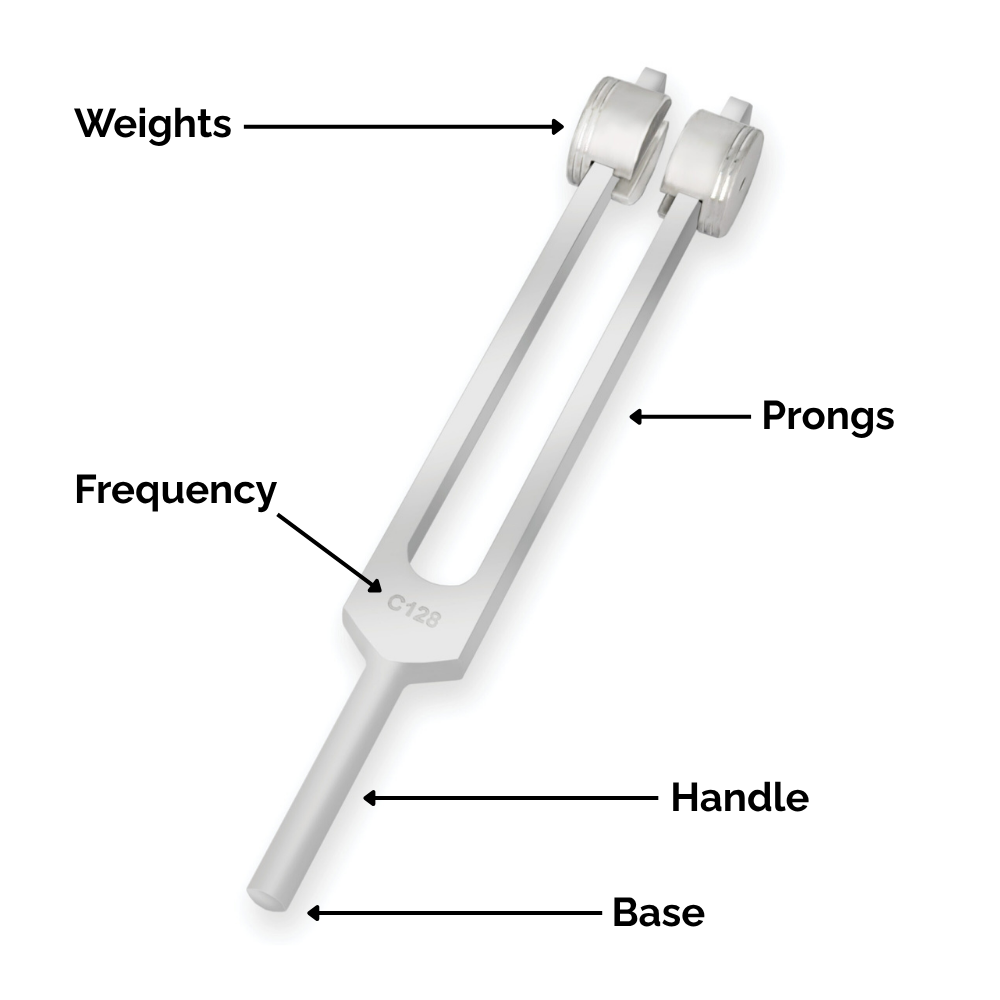
Prongs (also called tines or legs)
The prongs are the two arms that make the sound. When you strike the fork, they move back and forth very quickly, and that movement creates the tone.
Prong length is the main thing that sets the pitch. Longer prongs generally give a lower frequency, and shorter prongs give a higher one. The width and mass of the prongs also affect the frequency, which is why two forks of the same length can ring at different notes.
Weights
Weights are the round blocks fixed to the tips of the prongs. The extra mass slows the prongs down, which lowers the frequency without making the prongs longer.
This matters for low-frequency forks. Without weights, a fork tuned to 128 Hz would need very long prongs, and long prongs can clatter against each other. Weights also make the fork's vibration stronger and longer-lasting when you rest the base on the body.
A fork with weights is called weighted.
A fork without them is called unweighted.
Frequency Marking
The number stamped or laser-etched on the fork is its frequency, measured in hertz (Hz). Hertz means vibrations per second, so a 128 Hz fork's prongs move back and forth 128 times every second.
Some forks also carry a letter, such as the C in C128. That letter is the musical note the fork plays.
Handle (also called the Stem)
The handle is the part you hold. Always hold a fork by its handle, never by the prongs, because touching the prongs stops the vibration straight away.
The vibration travels from the prongs, down through the handle, and out through the base.
Base
The base is the end of the handle that you place on the body when using the fork for vibration.
Weighted vs Unweighted at a Glance
Choose weighted forks for use on the body and unweighted forks for use around the body.
| Weighted | Unweighted | |
|---|---|---|
| Main use | Placed on the body, so the vibration is felt | Held near the ears or body, so the sound is heard |
| Sound | Quieter, felt more than heard | Louder, clearer and longer-ringing tone |
| Vibration through the base | Strong | Light |
| Typical frequencies | Lower, for example 128 Hz or Mid Ohm 136.10 Hz | Often higher, for example Chakra, Meridian and Solfeggio sets |
Practitioners often have both: a weighted fork for on-body work and an unweighted set for sound work. Some of our sets, such as the Solfeggio Tuning Fork Set, come in weighted and unweighted versions.
How to Read a Tuning Fork's Name
A full product name tells you four things. Take our diagram's fork, a Weighted Aluminium C 128Hz Tuning Fork:
| Part of the name | What it tells you |
|---|---|
| Weighted | It has weights on the prongs, so it's designed for use on the body |
| Aluminium | Machined (not moulded) from solid aluminium bar stock |
| C | The musical note it plays |
| 128Hz | The frequency, meaning 128 vibrations per second |
Work through these two questions in order:
- Will you use it on the body or around it? On the body means weighted. Around the body means unweighted.
- Which frequency does your modality use? Kinesiology practitioners often start with a Mid Ohm 136.10 Hz fork or a 128 Hz Otto fork. Chakra, Meridian and Solfeggio work each use their own specific sets. Our Practitioner's Guide to Choosing Tuning Forks walks through each frequency family.
All our forks are cut from solid, high-grade, lead-free aluminium and individually calibrated, so whichever you choose, you're getting the same quality and craftsmanship.
Good starting points:
- Mid Ohm Tuning Fork or the Mid Ohm Tuning Fork Kit
- 128 Hz Otto Tuning Fork
- 528 Hz Tuning Fork
- Set of 2 C 256Hz and G 384Hz Tuning Forks
How to Activate and Care for your Fork
Activating: Hold the fork by the handle and tap the side of the prongs, near the tips, against an activator. A puck, mallet or round activator all work well.
Avoid: Striking the fork on hard surfaces such as tables, benches or other forks. This can dent the prongs and change the tuning.
Stopping the sound: Touch the prongs gently with your fingers.
Cleaning: Wipe the fork with a soft cloth after each client, as you would any equipment that touches skin.
Storing: Keep forks in a pouch so they don't knock together. We stock 8-fork and 9-fork pouches.
Frequently Asked Questions
Getting Started with Tuning Forks
Now that you know the parts, you can read any product name and know what you're getting.
Browse our Ohm Tuning Forks or Chakra, Meridian & other Tuning Forks.
If you're still unsure which fork suits your practice, get in touch and we'll help you choose.