
C & G Tuning Forks: A Practitioner's Guide to the Perfect Fifth
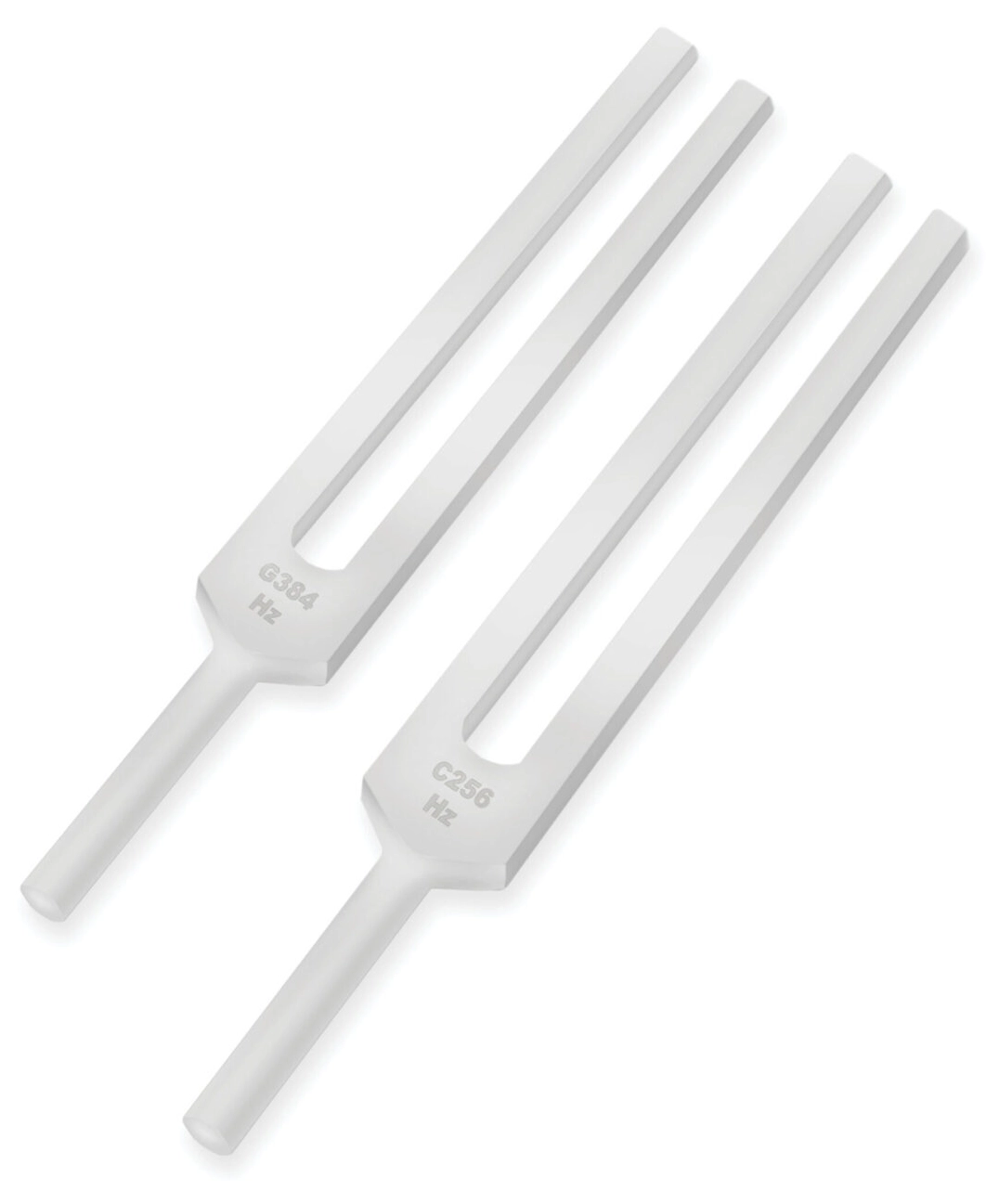
Strike a C 256 Hz tuning fork and a G 384 Hz tuning fork together and you hear one of the most recognised intervals in music and sound therapy: the Perfect Fifth.
For practitioners working hands-on with clients, the first few minutes of a session can set the tone for everything that follows. When a client arrives feeling busy, tense or distracted, creating a sense of calm and grounding can help them settle into the session and become more receptive to the work.
The C 256 Hz and G 384 Hz tuning fork pair offers a simple way to introduce sound at the beginning of a treatment. Together, the two frequencies form a Perfect Fifth, a naturally consonant interval valued for its balanced, harmonious quality.
For kinesiologists, sound therapists, energy practitioners and bodyworkers, these forks can be incorporated into a session in a number of practical ways. In this post, we'll explore what makes the Perfect Fifth unique, why C and G work so well together, and how you can use the forks with your clients.
What is the Perfect Fifth?
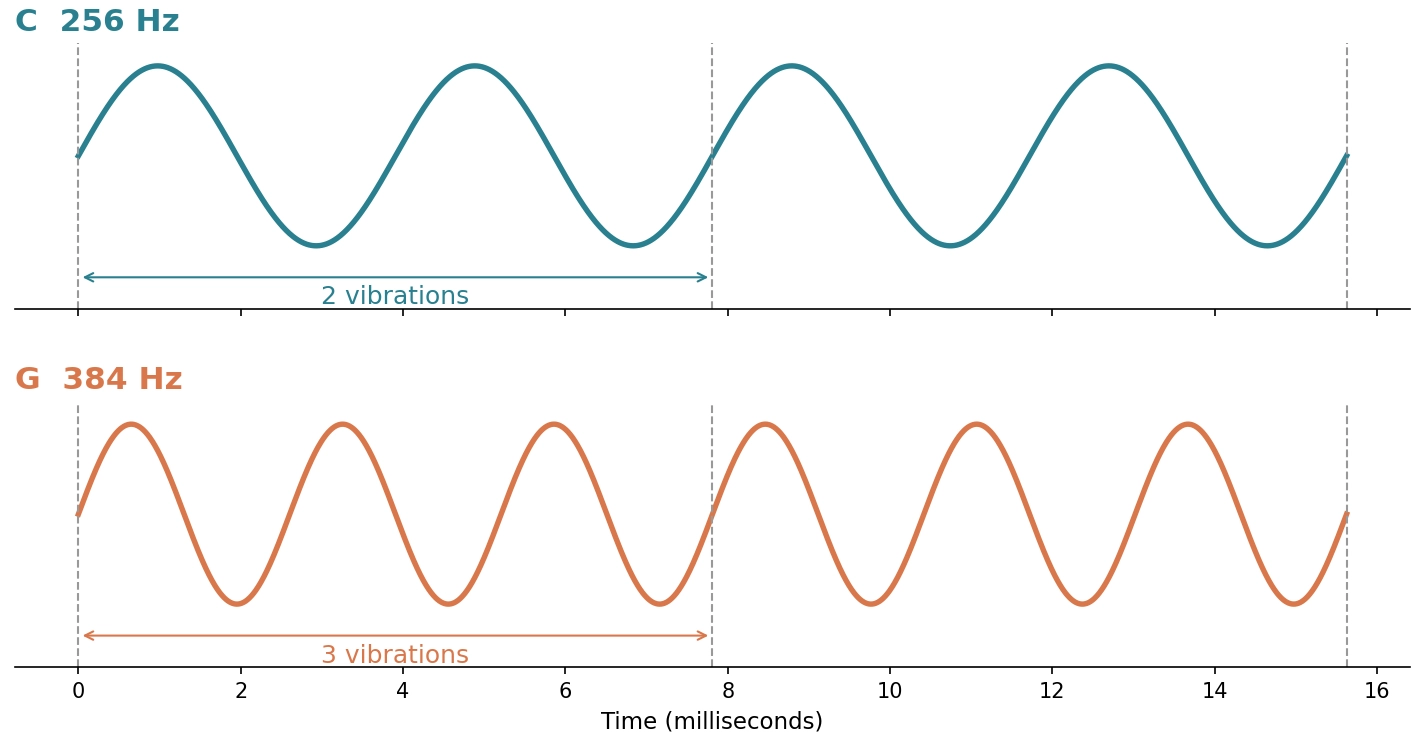
A Perfect Fifth is two notes whose frequencies sit in a simple 3:2 ratio.
The C and G forks show this exactly: 384 ÷ 256 = 1.5. For every two vibrations of the C fork, the G fork completes three.
That clean, whole-number relationship is why the sound feels so open and stable. The two waves line up regularly, so the ear hears smooth consonance rather than tension.
Tuned to the Pythagorean or Just Scale. Our forks are tuned to the Pythagorean or Just Scale, which builds notes from pure whole-number ratios. The Greek philosopher Pythagoras famously studied these ratios on a single string and found the 3:2 fifth to be one of the purest intervals of all. (C at 256 Hz is sometimes called "scientific" or "philosophical" pitch, slightly lower than modern concert tuning, and it pairs neatly with G at 384 Hz.)
Why they're called Whole Body Tuners. Because the Perfect Fifth is so balancing, C and G forks are often known as Whole Body Tuners. Rather than focusing on one area, they're used to bring the whole person back into a sense of harmony, which makes them a natural fit for opening, closing and integrating a session.
The Perfect Fifth across cultures and traditions
Few sounds carry as much story as the Perfect Fifth. Across the world, it has been woven into myth, philosophy and healing practice.
- India: Shiva and Shakti. In Hindu thought, Shiva represents pure, still awareness and Shakti the creative energy that sets the universe in motion. The fifth is linked with the moment the two meet, when stillness and movement join in the cosmic dance of creation.
- Polarity Therapy: energy in motion. Polarity Therapy, founded by Dr Randolph Stone, sees health as the free flow of energy between opposite poles. Sound healer and Polarity practitioner Dr John Beaulieu brought the C and G forks into this work, where the fifth reflects how body and subtle energy are always moving and rebalancing.
- Ancient Greece: Apollo and the dolphins. Apollo was the Greek god of both music and healing, and his lyre was tuned to pure intervals like the fifth. One myth tells how he took the form of a dolphin to guide sailors to Delphi, his sacred site, whose name echoes the Greek word for dolphin.
- Ancient China: the harmony of Yin and Yang. Taoist philosophy, traced to Lao Tzu, describes life as the interplay of Yin and Yang, two opposites that complete each other. Sound healers often describe the fifth the same way: two distinct notes that together create a feeling of wholeness.
Different cultures, one shared idea: the Perfect Fifth brings opposites together into balance.
What the C and G forks bring to your sessions
The Perfect Fifth is a versatile tool because it works at the level of the whole person. Practitioners commonly use it to:
- Settle clients quickly. A few rounds of the fifth at the start of a session gives an anxious or overstimulated client something simple to focus on, helping them shift out of "fight or flight".
- Create a clear start and finish. Sounding the forks to open and close a treatment marks the session as its own space, and helps clients leave feeling grounded rather than floaty.
- Support stress release. The steady, consonant tone is a gentle way to help clients let go of held tension, especially when they struggle to relax on the table.
- Complement balancing work. Used before or after a correction or balance, the forks offer a way to help integrate the changes you've made.
- Work in the energy field. In energy-based modalities, the forks are swept through the space around the body to smooth and harmonise its flow.
- Reset your own space. Many practitioners also sound the fifth between clients to clear the room and re-centre themselves.
Frequently Asked Questions
Add the Perfect Fifth to your practice
From Pythagoras to Polarity Therapy, the Perfect Fifth has long been valued as the sound of balance.
With the C and G set in your kit, you have a simple, effective way to help clients settle, integrate and leave feeling whole.