
The Ohm Frequency: 136.1 Hz Explained
Learn where the Ohm frequency comes from, how it differs from the Schumann Resonance, and how to use the six Ohm forks in unisons and octaves.
If you work with tuning forks in kinesiology, acupressure, bodywork or sound therapy, the Ohm frequency, 136.1 Hz, is probably already in your kit. The Mid Ohm is the fork many practitioners reach for first, for placing on acupoints, along meridians or over areas of tension.
But knowing how to use a fork isn't the same as knowing why it's tuned the way it is. And sooner or later, a client will ask.
This guide gives you a clear, accurate answer to that question. It also shows you how the whole Ohm range fits together, so you can choose your next fork based on how you work rather than guesswork.
We'll cover:
- Where 136.1 Hz comes from, and how to explain it to a client in a sentence
- Why every fork in the Ohm Therapeutics range is the same note at a different octave
- How the Ohm frequency differs from the Schumann Resonance
- How to use Ohm unisons and octaves in a session
- Which fork to add next, depending on your modality
What is the Ohm frequency?
The Ohm frequency is 136.1 Hz, the frequency of the Earth's orbit around the Sun raised 32 octaves into the range of human hearing. It's the tone of the classic Mid Ohm tuning fork and the foundation of the Ohm Therapeutics sound healing system.
Where 136.1 Hz comes from
The number was calculated by Hans Cousto, a Swiss mathematician and musicologist, and published in his book The Cosmic Octave.
His idea was simple. Any cycle in nature has a frequency, even an extremely slow one, and any frequency can be doubled again and again until it lands in the range of human hearing. Doubling a frequency raises it by exactly one octave, and the octave is the one musical interval where a note keeps its identity. So a natural cycle can be brought up into audible sound without changing what it fundamentally is.
Cousto applied this to the Earth's orbit around the Sun:
- One year (a tropical year) is 365.242 days, or about 31,556,925 seconds.
- As a frequency, a cycle that slow is 1 ÷ 31,556,925, or roughly 0.0000000317 Hz. Far too slow to hear or feel.
- Raised 32 octaves (doubled 32 times), it becomes 136.10 Hz.
That's the whole calculation. 136.1 Hz is the Earth's orbital year raised thirty-two octaves: a single year, sped up until it becomes a pitch you can hear and a vibration you can feel in your hands.
One frequency, six forks: the Ohm octave series
This is the part many explanations skip, and it's the part that makes the Ohm Therapeutics range make sense. Every Ohm fork is the same note at a different octave.
| Fork | Frequency | Octaves above the orbital year | Type | Main use |
|---|---|---|---|---|
| Osteo Ohm | 34 Hz | 30 | Weighted | On the body: dense tissue, bone and joints |
| Low Ohm | 68.05 Hz | 31 | Weighted | On the body: deeper, more grounding work |
| Mid Ohm | 136.1 Hz | 32 | Weighted | On the body: the classic Ohm fork |
| High Ohm (pair) | 272.2 Hz and 544.4 Hz | 33 and 34 | Unweighted | Off the body: in the energy field |
| Sonic Ohm | 1088.8 Hz | 35 | Unweighted | Off the body: clearing and finishing |
Six forks, one note. Choosing between them isn't choosing between different frequencies. It's choosing where along the octave series you want to work: low and slow for dense tissue and grounding, high and bright for the energetic field.
Where most practitioners start
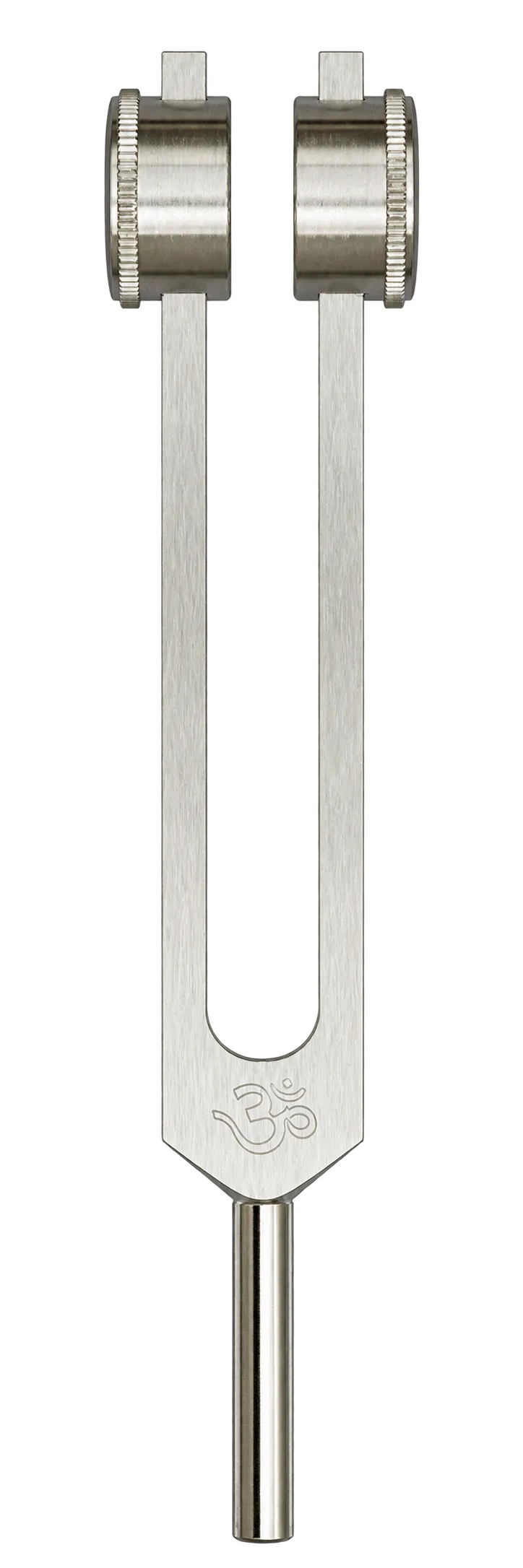
The Mid Ohm at 136.1 Hz sits in the middle for a reason. It's low enough that a weighted fork transmits a clear, palpable vibration into the body, and high enough to carry an audible tone. That combination is why it's the classic Ohm fork and the one almost every practitioner starts with.
View the Mid Ohm fork →
Weighted and unweighted in the Ohm range
The three lower forks (Osteo, Low and Mid Ohm) are weighted. The weights add mass to the prong tips, which sends more of the vibration down through the handle, so your client feels it when you place the base of the fork on the body.
The three higher forks (the High Ohm pair and the Sonic Ohm) are unweighted. They ring louder and are used off the body, where the focus is on the sound. Weights are generally only used on lower-frequency forks. On higher forks the prongs are too short to carry them and still give the right note.
Either way, the accuracy of the frequency is the same. The weights change how the vibration is delivered, not what note it is. For more on this, see our Anatomy of a Tuning Fork guide.
Why it's called the "Ohm" frequency
The maths gives you a number. The name comes from somewhere else.
Musically, 136.1 Hz is very close to the note C# (C sharp). If you sound a Mid Ohm fork next to a piano, you'll hear it sitting just under the piano's C#.
You may also see the Ohm frequency linked to 432 Hz tuning. That's because some musicians tune their instruments slightly lower than the modern standard, and on an instrument tuned that way, C# lands almost exactly on 136.1 Hz. It's a happy coincidence rather than where the number comes from, but it's why the two are so often mentioned together.
That pitch region has a long history in Indian classical music, where the tanpura drone and the chanted OM (Om or Aum) traditionally sit. Om is considered the primordial sound in Hindu cosmology, and an entire text, the Mandukya Upanishad, is devoted to it. Cousto's calculation and that tradition arriving in the same place is what earned 136.1 Hz its name.
The Ohm frequency vs the Schumann Resonance
These two are confused constantly, because both get described as "the Earth's frequency." One is the planet's electromagnetic field. The other is its journey around the Sun.
The Schumann Resonance is named after German physicist Winfried Otto Schumann. It's a set of electromagnetic standing waves in the cavity between the Earth's surface and the ionosphere, driven by lightning, with a fundamental around 7.83 Hz and harmonics running up past 30 Hz. It is measurable, and it varies with storm and solar activity.
The Ohm frequency is an acoustic frequency calculated from the Earth's orbital period. It doesn't fluctuate, because the length of the year is effectively constant.
| Ohm frequency | Schumann Resonance | |
|---|---|---|
| What it is | The Earth's orbital year, raised into audible sound | Electromagnetic waves between the Earth's surface and the ionosphere |
| Frequency | 136.1 Hz (and its octaves, down to 8.5 Hz and below) | About 7.83 Hz, with higher harmonics |
| How it's known | Calculated from the length of the year | Measured with sensitive instruments |
| Constant? | Yes | No, it shifts with lightning, solar activity and the atmosphere |
| Linked to a cycle or season? | Yes, the solar year | No |
| Traditional or spiritual basis? | Yes, associated with OM | No |
| Used in sound healing? | Yes | Yes |
The clearest way to see that they're unrelated: raise 7.83 Hz by octaves and you get 62.6 Hz, then 125.3 Hz, then 250.6 Hz. It never lands on 136.1. Different phenomenon, different calculation, different note.
Working with Ohm unisons and octaves
Because the whole range is one octave series, the forks are designed to be used in pairs.
- The unison promotes balance. Two forks of the same frequency, used together.
- The octave promotes movement. Two forks an octave apart, creating movement up and down the axis of the root tone.
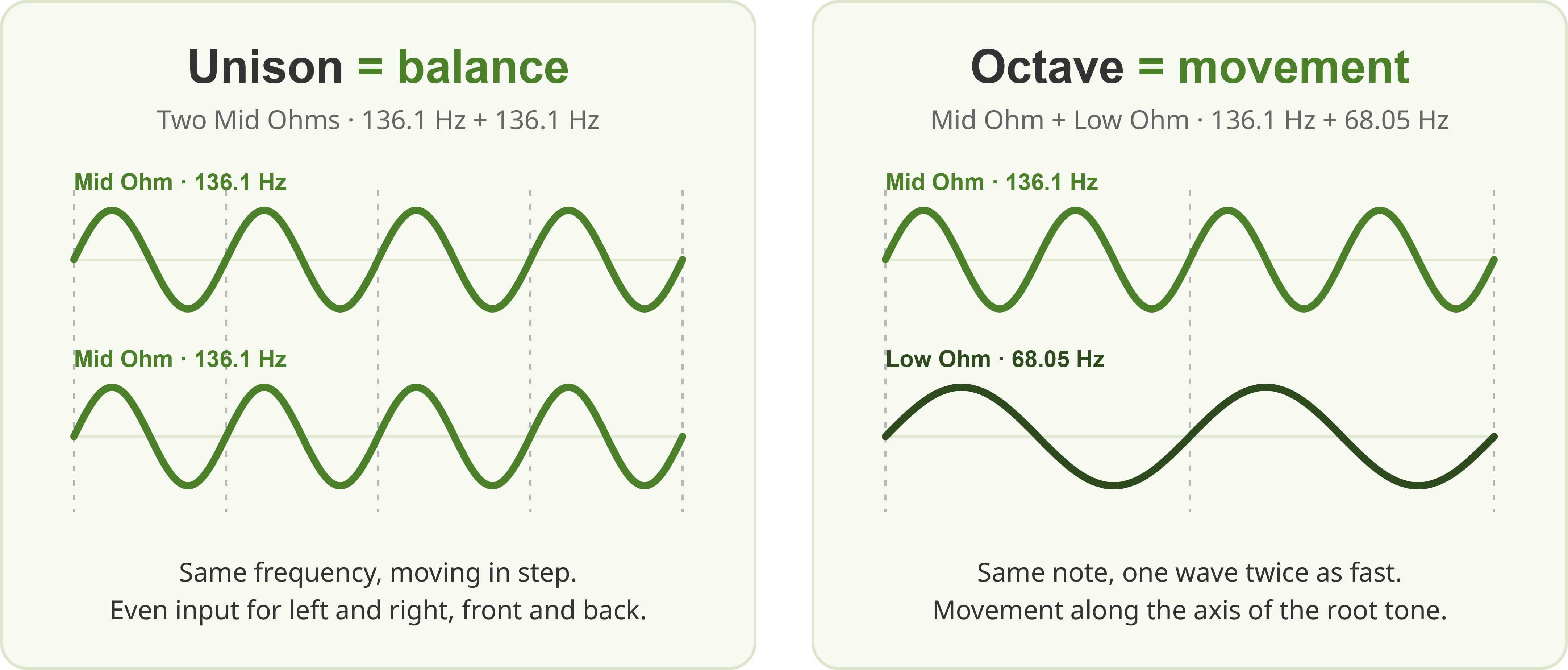
In practice, the pairings look like this:
| Pairing | Forks | How practitioners use it |
|---|---|---|
| Ohm Unison | Two Mid Ohms (136.1 + 136.1 Hz) | The foundation of the system. Allows balanced bilateral work (left and right, front and back) and distal applications. |
| Low Ohm Unison | Two Low Ohms (68.05 + 68.05 Hz) | Suggested for more deeply rooted patterns. |
| Ohm Octave | Mid Ohm + Low Ohm (136.1 + 68.05 Hz) | Used to loosen stuck or rigid energy and open meridian pathways. |
| Low Ohm Octave | Low Ohm + Osteo Ohm (68.05 + 34 Hz) | Often used around joints and bone. |
| High Ohm Octave | 272.2 + 544.4 Hz | Used off the body to help disperse tension and energetic "armouring" held after stress. |
| Sonic Ohm Octave | 544.4 + 1088.8 Hz | A few sweeping passes to finish a session and help the client transition from deep relaxation back to alertness. |
A simple way to think about it: the weighted octaves (Ohm and Low Ohm) work with the physical body, and the unweighted octaves (High and Sonic Ohm) work with the subtle body or energy field.
Using Ohm forks in a session
How you apply the forks will depend on your modality and training, but these are the most common approaches practitioners use.
Weighted forks on the body
Activate the fork, then gently place the base of the handle on the body. Common placements include:
- Acupoints and meridians (sometimes called Sonopuncture), or stroking along a meridian line.
- Muscles, ligaments and joints, such as the shoulders and lower back.
- Reflex zones of the feet, hands and ears.
- Chakras, or the transition points between them, front or back.
- Paired placements with two forks to balance left and right, top and bottom, or front and back.
The vibration travels beyond the contact point into the surrounding tissue, so there's some margin for error. If you're working within an acupuncture framework, though, accurate point location is still recommended.
Try each fork on yourself first, in different places, so you know what your client will feel.
For kinesiologists: let the body choose
Ohm forks fit easily into an existing kinesiology balance. Instead of following a fixed protocol, you can use muscle monitoring to find out whether the client needs the frequency, which fork or octave, where to apply it, and when the application is complete. That lets you use the forks as a tool inside your existing work rather than as a separate modality.
Unweighted forks off the body
Activate the fork and hold or move it around the client, sweeping through the energy field. Practitioners also use the higher forks to clear a treatment room between clients, or hold a fork near a vessel of flower essences or other vibrational remedies.
Where to start
You don't need the full range to begin. One Mid Ohm fork and an activator will do more for your practice than a full set you haven't learned yet. 136.1 Hz is the centre of the whole system, so learn it first, then decide which direction along the octave series your work wants to go.
For most practitioners, the progression looks like this: Mid Ohm → a second Mid Ohm → add a Low Ohm → expand into the wider octave range.
- Starting out: Mid Ohm Tuning Fork Kit
- Bilateral and balancing work: Mid Ohm Set (the Ohm Unison)
- Adding movement: Ohm Octave Set
- Working with the energy field: High Ohm Set and Sonic Ohm Kit
- A complete practitioner kit: Basic Ohm Set or Advanced Ohm Set
- Learning the placements: Ohm Instructional Chart and Application DVD
Frequently Asked Questions
No, but they're related. On an instrument using 432 Hz tuning, the note C# lands almost exactly on 136.1 Hz, which is why the two are often mentioned together. The Ohm frequency itself comes from the length of the Earth's year, not from 432 Hz tuning.
Add the Ohm frequency to your practice
136.1 Hz sits at the meeting point of several ideas: the Earth's annual cycle, the musical principle of the octave, the traditional association with OM, and a modern system for bringing sound and vibration into therapeutic practice.
For practitioners, though, its value comes down to application. It's the anchor of an entire octave system you can build on as your practice grows.

Mid Ohm Tuning Fork
The 136.1 Hz Mid Ohm Tuning Fork Kit is the anchor of the Ohm octave system, and the natural first fork for your practice.